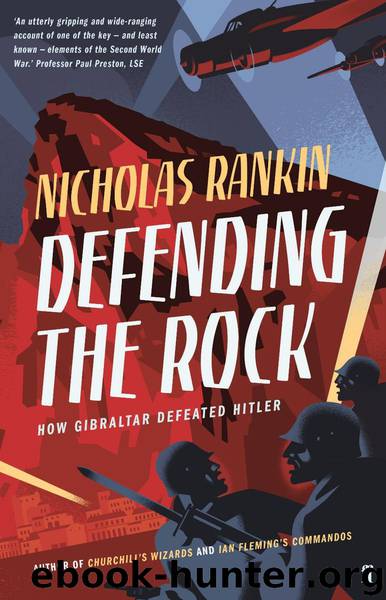
Defending the Rock by Nicholas Rankin
Author:Nicholas Rankin [Nicholas Rankin]
Language: eng
Format: epub
ISBN: 9780571307739
Publisher: Faber & Faber
Published: 2017-09-16T04:00:00+00:00
Field Security was a good billet for the quick-witted and worldly wise in the Second World War. Geoffrey Household and Norman Lewis, who served separately in different Field Security posts across the Levant, North Africa, Greece and Italy, both describe in their autobiographies how enterprising Field Security NCOs could take advantage of their curious status, somewhere between military police and intelligence officers. Most people were simply not sure what Field Security was, or what exactly its people were supposed to be doing.
‘A Field Security Section’, wrote Geoffrey Household, ‘consisted of an officer, a sergeant-major and twelve NCOs. Its transport was a truck and thirteen motor-cycles; its armament fourteen pistols and a typewriter; its other lethal weapons, its comforts, its blankets and its furniture, when it had any, were whatever it could more or less legally acquire …’ The primary duty of an FS section, Household further explained in Against the Wind, was to take precautions for the security of the division or corps to which it was attached – which meant discreetly supervising all civilians the formation dealt with. They also had to investigate leaks of information and guard against the curiosity of enemy intelligence. Household thought this was interesting work, because ‘the section became the eyes, ears, languages and mobile reserve of I(b) …’*
People in Field Security came from ‘commerce, teaching, journalism, the law, the stock exchange: men of education with languages or experience which specially fitted them for the work. In those early days promotion from lance-corporal to lieutenant and then to captain could be very rapid …’
Norman Lewis thought that Field Security NCOs were regarded with suspicion, ‘seen as knowing more than was good for them, of being too clever by half, potentially dangerous, and therefore to be kept under constant supervision’ by a sporty officer and a reliable company sergeant major. In his biography of Lewis, Semi-invisible Man, Julian Evans describes Field Security Sections as ‘half envied, half distrusted, virtually autonomous’, and lists their duties as guarding wartime ports against looting and sabotage, inspecting vessels and aircraft, securing buildings, searching houses, rounding up suspects, arresting people, interrogating prisoners, escapers and refugees, vetting war brides, watching brothels and prostitutes, and trying to intercept Axis agents.
Mobilised on 18 September 1940, Scherr’s No. 54 Field Security Section left Liverpool the next day in convoy OG 43, Outward to Gibraltar No. 43. A recent tragedy meant the section was a reconstituted one. The first 54 FSS party had embarked with hundreds of sappers, gunners and pioneers on a Rock-bound ship, Mohamed Ali el-Kebir, but they had been torpedoed by the German submarine U-38 in the Western Approaches on 7 August, 230 miles west of Ireland’s Bloody Foreland. The doomed transport ship was the same vessel that had evacuated the thousands of Gibraltarian civilians to Casablanca in May and June of that year. Mohamed Ali el-Kebir’s master, John Thomson, died with his ship, as did the ship’s doctor, eight other merchant navy crewmen, four Royal Navy sailors and eighty-two British army
Download
This site does not store any files on its server. We only index and link to content provided by other sites. Please contact the content providers to delete copyright contents if any and email us, we'll remove relevant links or contents immediately.
| Africa | Americas |
| Arctic & Antarctica | Asia |
| Australia & Oceania | Europe |
| Middle East | Russia |
| United States | World |
| Ancient Civilizations | Military |
| Historical Study & Educational Resources |
The Radium Girls by Kate Moore(12028)
100 Deadly Skills by Clint Emerson(4925)
Rise and Kill First by Ronen Bergman(4788)
The Templars by Dan Jones(4689)
The Doomsday Machine by Daniel Ellsberg(4490)
The Rape of Nanking by Iris Chang(4213)
Killing England by Bill O'Reilly(4001)
Stalin by Stephen Kotkin(3965)
Hitler in Los Angeles by Steven J. Ross(3946)
12 Strong by Doug Stanton(3550)
Hitler's Monsters by Eric Kurlander(3342)
Blood and Sand by Alex Von Tunzelmann(3203)
The Code Book by Simon Singh(3189)
Darkest Hour by Anthony McCarten(3133)
The Art of War Visualized by Jessica Hagy(3007)
Hitler's Flying Saucers: A Guide to German Flying Discs of the Second World War by Stevens Henry(2754)
Babylon's Ark by Lawrence Anthony(2678)
The Second World Wars by Victor Davis Hanson(2524)
Tobruk by Peter Fitzsimons(2516)
